Signs you need this
- The same order is entered in two or three tools.
- Sales numbers and accounting numbers don't match.
- Customer orders and supplier orders aren't linked.
- A report means exporting files from several places and merging by hand.
The cost: time spent reconciling, numbers that disagree, and slow decisions because nobody trusts the figures.
What it covers, and what it doesn't
Covers
- A data map: which tool holds what, who enters it, who uses it.
- One source of truth for each kind of number: customers, orders, receivables.
- Linking data between the tools you use, where those tools allow it.
- Read-only reports pulled from outside platforms.
Doesn't cover
- Promising up front that an outside platform can be connected. We check that in the assessment.
- Migrating all historic data before knowing what's still used.
- Replacing every tool you use with one new system.
A typical workflow, before and after
Illustrative example · A typical workflow to picture the change. Not a specific customer, and no figures.
Before
- Customer orders live in the sales spreadsheet.
- Supplier orders live in the purchasing spreadsheet.
- Ad reports are read on each platform and copied by hand into a weekly report.
After
- Customer and supplier orders are linked in one system.
- A confirmed line with no supplier order is flagged straight away.
- Ad reports are pulled in read-only, next to the sales numbers.
Principles for connecting data
Least access
Each connection reads or writes only what the agreed job needs.
Read-only by default
Outside sources are read-only unless you approve otherwise.
One source per number
Each number has one home; everything else reads from it, nothing is copied by hand.
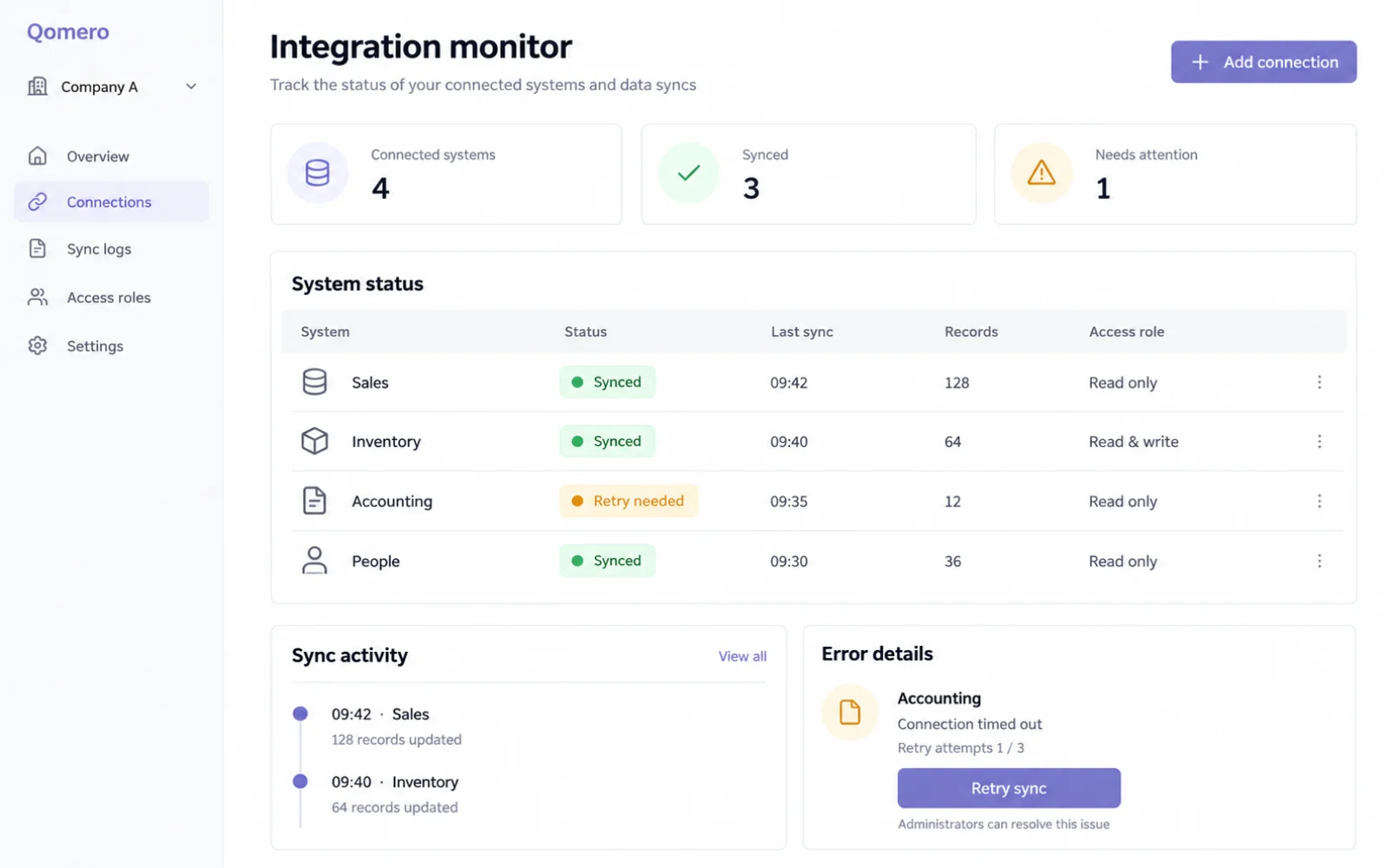
A broken link gets noticed
Design principle: connection failures go to a named person, never silently skipped.
What you get, and what counts as done
- Written findings: which tool holds which data, where numbers diverge, which connections are feasible. You keep them.
- Scope and quote for each phase, fixed before work starts.
- A phase is done only when your team uses numbers from the new source instead of merged spreadsheets.
- After 30 days of real use, a before-and-after on the numbers agreed up front.
Qomero promises no connection or result before the operational assessment.