Signs you need this
- Work changes hands in chat groups; nobody knows who has it.
- A supplier order runs late and you hear when the customer calls.
- Approvals wait on one person; when they're away, work stops.
- Key rules live in one person's head.
- The same figures are typed into several places.
The cost: your best people's time goes into repetition, and mistakes show only once they've become problems.
What it covers, and what it doesn't
Covers
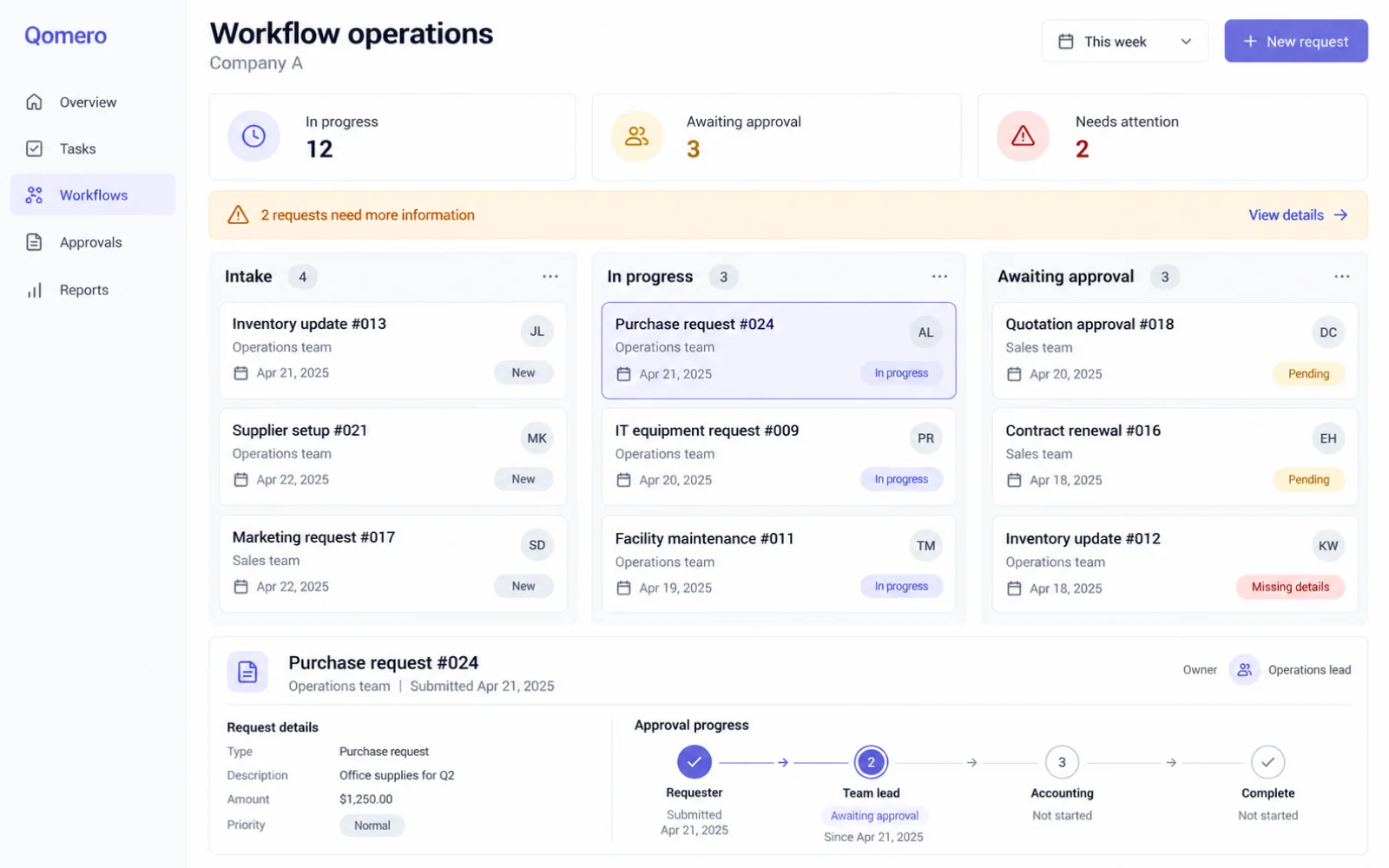
- A process map: which steps, who does them, who approves, when work moves on.
- Business rules kept in the system, not in one person's head.
- Follow-up tasks created by named rules, each with an owner.
- Alerts when work runs late or a step is missing.
- The status of every job, visible without asking.
Doesn't cover
- Automating a process nobody has agreed on. Standardise first, automate second.
- Letting a machine decide where a wrong call is costly.
- Promising hours saved before the current state is measured.
A typical workflow, before and after
Illustrative example · A typical workflow to picture the change. Not a specific customer, and no figures.
Before
- Sales takes an order and messages purchasing in a chat group.
- Purchasing orders from the supplier and logs it in its own spreadsheet.
- Nobody knows the supplier order is late until the customer asks.
After
- A customer order creates a task for purchasing, with a named owner.
- The supplier order is linked to the customer order.
- When a supplier order passes its ready date, the owner is alerted.
- Managers see which step work is stuck at.
Who owns the rules, who answers for the result
You approve the rules
Every automated rule is written down and approved by you before it runs.
An owner for every step
Even where a machine does the step, a person answers for the result.
Exceptions go to people
Cases a rule can't handle go to a person; the system doesn't guess.
Status from the system
Progress reports read from the system, not from hand-merged reports.
What you get, and what counts as done
- Written findings on the current process: bottlenecks, what needs only a management change, where a system helps. You keep them.
- Scope and quote for each phase, fixed before work starts.
- A phase is done only when your team uses it instead of the spreadsheet.
- After 30 days of real use, a before-and-after on the numbers agreed up front.
Qomero promises no result before the operational assessment.