Signs you need this
- To see what a customer owes, you ask accounts.
- Repeat customers are due to reorder and nobody prompts them.
- A quote went out, and nobody knows if the customer answered.
- A salesperson leaves, and the customer history leaves too.
- You review the pipeline by asking each person.
The cost: missed reorders, overdue debt noticed late, decisions on stale numbers.
What it covers, and what it doesn't
Covers
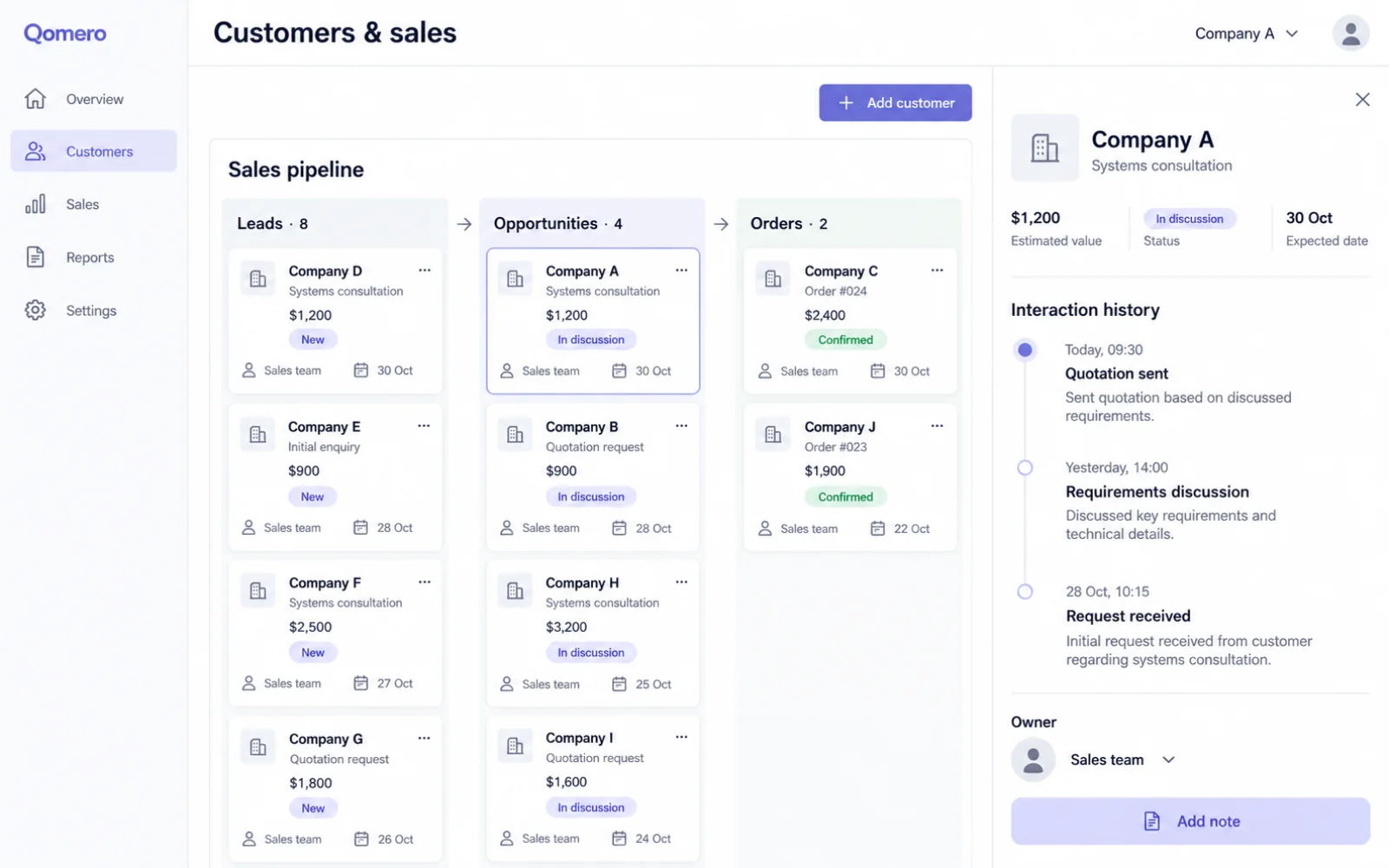
- One record per customer: opportunities, quotes, contracts, orders, receivables.
- A pipeline shaped to how your industry actually sells.
- A daily attention list: due to reorder, gone quiet, unanswered quote, overdue.
- Customer interaction history, noted after each meeting.
- A forecast of committed, likely and potential sales.
Doesn't cover
- Tax accounting and statutory books.
- Sales websites and running ads.
- Replacing a full ERP in one go.
A typical workflow, before and after
Illustrative example · A typical workflow to picture the change. Not a specific customer, and no figures.
Before
- Each salesperson keeps their own customer spreadsheet.
- Quotes go out by message and are tracked from memory.
- At month end, a manager merges spreadsheets into a report.
- Only accounts knows which customers owe money.
After
- Customers, quotes, orders and receivables sit in one record.
- Each morning, salespeople get a call list with reasons.
- Managers see pipeline and forecast whenever they need.
- Salespeople see a customer's balance before they call.
Data, permissions and reporting
Who sees and edits what
Role-based view and edit rights are fixed at the scoping step.
Salespeople see their own
Each salesperson sees their customers and numbers; managers see the whole team.
AI suggests, sales decides
Next steps come with a reason. A task is created only when the salesperson clicks.
Reports from the same data
Reports read the data the team uses every day, not hand-merged spreadsheets.
What you get, and what counts as done
- Written findings on your current sales process. You keep them, whether or not you go on.
- Scope and quote for each phase, fixed before work starts.
- A phase is done only when the sales team uses it instead of the spreadsheet.
- After 30 days of real use, a before-and-after on the numbers agreed up front.
Qomero promises no result before the operational assessment.