Signs you need this
- To learn what one customer bought, someone has to filter spreadsheets.
- Staff paste company data into outside AI tools.
- AI answers sound plausible, but nobody knows where they came from.
- Nobody knows what data AI may see, or what it may write.
- When AI gets it wrong, nobody knows who's accountable.
The cost: decisions on answers nobody can check, and data leaving the company unnoticed.
What it covers, and what it doesn't
Covers
- Answers to questions about your data, with the source records.
- Suggested next steps, with reasons and evidence.
- Notes after a meeting: AI suggests what to record; a person confirms before it's saved.
- The data AI may read, set per role.
- A map of which work goes to AI, who approves, and which calls stay human.
Doesn't cover
- AI writing or changing data without a person's approval.
- AI making calls where a mistake is costly.
- Certificate courses, prompt libraries or headcount-cutting plans.
- Accuracy promises before testing on your real data.
A typical workflow, before and after
Illustrative example · A typical workflow to picture the change. Not a specific customer, and no figures.
Before
- A manager asks: which customers are due to reorder?
- Someone opens several spreadsheets, filters by hand, and replies when they get to it.
- The answer has no sources; checking it means starting over.
After
- The manager asks the assistant in plain language.
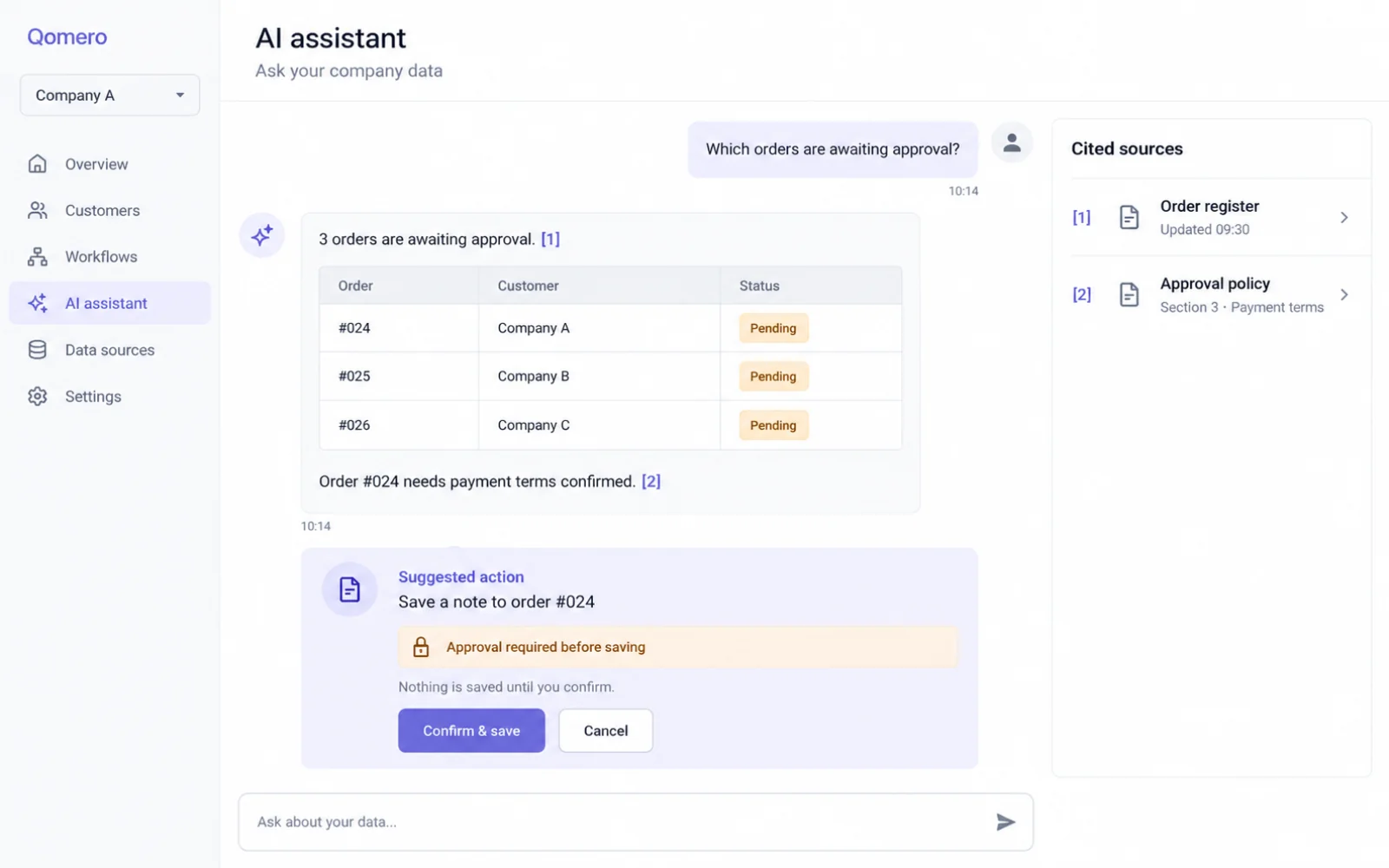
- The assistant answers with a list of the source records.
- The asker sees only data they are entitled to.
- To create a call-back task, the user clicks to confirm; AI doesn't create it.
Four lines AI does not cross
Grounded in sources
Every answer and suggestion cites its records. AI may reword a reason, never invent one.
Within permissions
AI shows only the data the person asking is allowed to see.
A person approves first
AI suggests; your people confirm. Nothing is saved until someone approves it.
Measured before and after
Compare time, rework and output quality on real work.
What you get, and what counts as done
- Written findings: which work suits AI, which stays human, which data AI may read. You keep them.
- Scope and quote for each phase, fixed before work starts.
- A phase is done only when your team uses it on real work.
- After 30 days of real use, a before-and-after on the numbers agreed up front.
Qomero promises no result or accuracy level before the operational assessment.